
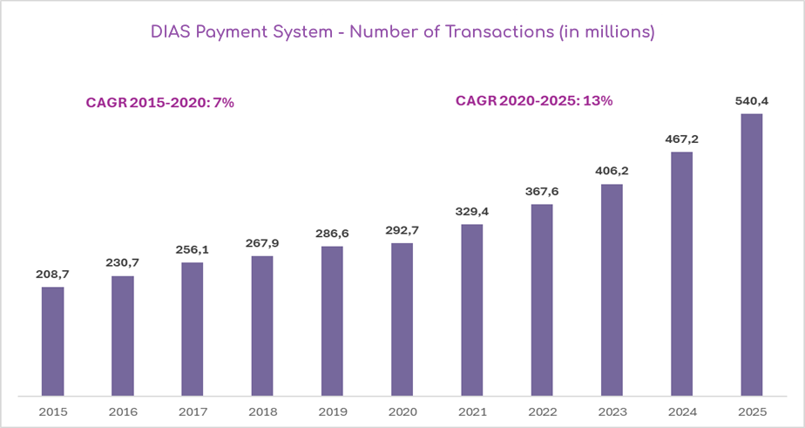
2025 also marked the strongest annual growth in transaction volumes in recent years. On average, 2.2 million transactions were processed daily (on business days), with a total daily value of €2.2 billion. A new daily peak was recorded on 24 November 2025, when 6 million transactions worth €3.5 billion were processed. This performance highlights the structural growth of the System and the increasing confidence of the market in DIAS’ infrastructures.
Transaction Growth & Acceleration of Development
The evolution of transaction volumes processed through the DIAS Payment System reflects a steady growth trajectory, which has significantly strengthened and accelerated over the past five years.
During the period 2015–2020, transaction volumes grew at an average annual rate (CAGR) of 7%, reflecting the gradual expansion of interbank payments and the systematic enhancement of the System’s core services.
In the period 2020–2025, growth accelerated substantially, reaching an average annual rate (CAGR) of 13%, driven by the evolution and scaling of DIAS’ infrastructures and services, the transition towards digital and instant payments, and the broader adoption of its services by banks, businesses and consumers.
This divergence clearly demonstrates that recent growth momentum is not merely a natural market evolution, but is directly linked to the active role of DIAS in shaping a modern and efficient payments environment.
Figure I
Transaction Value & Economic Impact
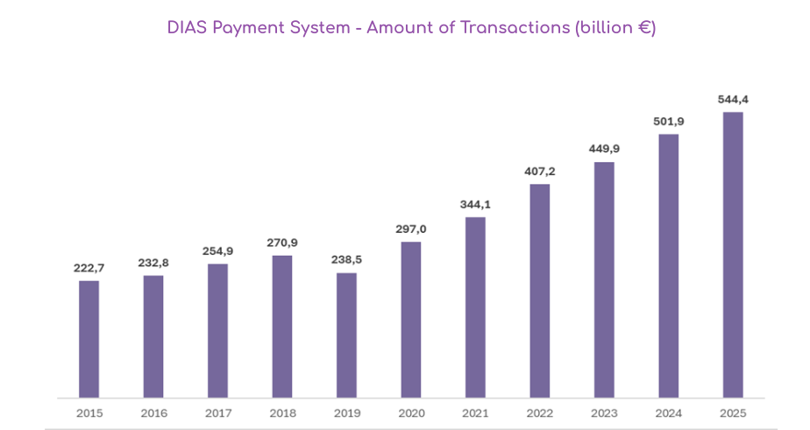
Alongside the increase in transaction volumes, 2025 also recorded a strong rise in the value of transactions processed through the DIAS Payment System. The total transaction value reached €544.4 billion, marking a new historical high.
This development highlights DIAS’ role not only as a high-volume infrastructure, but also as a key channel for the transfer of economic value for businesses, organizations and the public sector, supporting large-scale transactions with reliability and security.
Figure II
Instant Payments & IRIS: The Growth Catalyst
2025 confirmed the decisive role of instant payments and the IRIS Payments service in driving the overall momentum of the DIAS Payment System. The increasing adoption of real-time payments by individuals, professionals and businesses acted as a key accelerator of System usage, confirming the Greek market’s transition to real-time payment infrastructures.
Instant payments reached 122.1 million transactions in 2025, recording a 72.8% increase compared to 2024 and accounting for 27% of total credit transfers. This growing adoption was also reflected at an operational level, with the System recording a new processing peak in December 2025, handling 15.4 million instant payment transactions, up 78.6% year-on-year.
On 14 December 2025 at 20:26:20, the System achieved a new all-time high in instant payment processing, reaching 235 instant transactions per second, confirming its ability to operate reliably under conditions of increased demand.
IRIS P2P: Universal Adoption in Everyday Transactions
IRIS P2P continued its strong upward trajectory, reaching 111.4 million transactions in 2025 at product level — of which 81 million were interbank transactions — marking a 90% year-on-year increase (158 times higher than in 2020).
By December 2025, registered users reached 4.3 million, with 836,000 new users added during the year. Overall, the user base has increased eightfold compared to January 2020, confirming the universal adoption of the service.
IRIS P2Pro: Rapid Penetration among Professionals
IRIS P2Pro recorded particularly dynamic growth, reaching 583,445 registered professionals by the end of 2025. Transaction volumes increased by 197% compared to 2024 (409 times higher than in 2020).
The service is evolving into a core collection tool for professionals and sole proprietors, offering immediate liquidity and a simplified payment experience.
IRIS Commerce: Instant Payments at Scale
2025 marked the further maturation of IRIS Commerce, with transaction volumes increasing by 70.8% year-on-year and becoming sixteen times higher than in 2020.
The service is now widely available, strengthening the presence of instant payments across both physical and digital environments, covering approximately 1.2 million POS terminals and 70,000 e-shops.
Distribution of Transactions & Value by Service
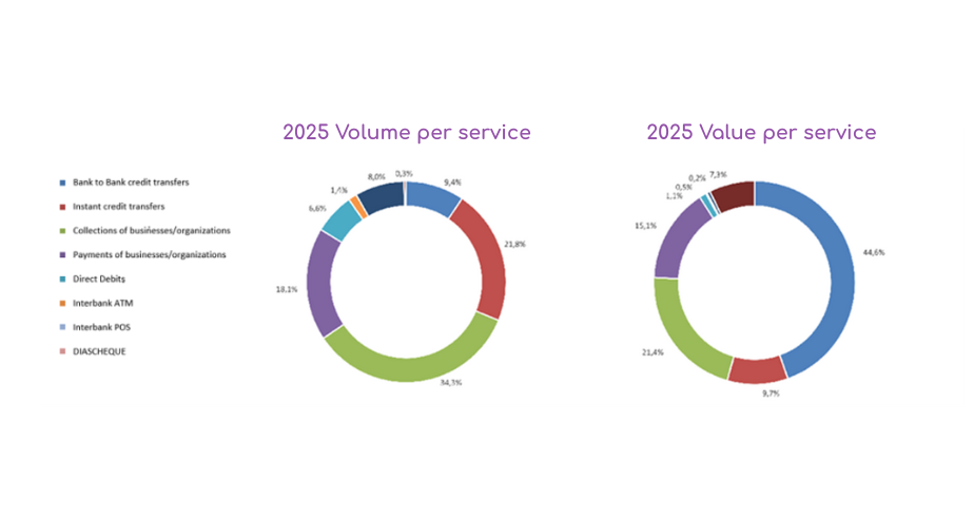
The corresponding charts illustrate the distribution of transaction volumes and values processed through the DIAS Payment System in 2025, by service category and sub-category.
The analysis highlights the multidimensional role of the System, which supports both high-frequency everyday services and transactions of significant economic value.
System-Wide Services & Ecosystem Development
In 2025, the DIAS Payment System continued to support the full spectrum of interbank payment services, ensuring their uninterrupted, reliable and secure operation in an environment of increased transaction volumes.
Among other services, interbank ATM transactions recorded a 27.7% increase compared to 2024, highlighting their continued relevance within the broader payments ecosystem.
At the same time, products and services such as RF/QR payments and standing orders, which automate collections for businesses and organizations, accounted for 38.6% of total System transactions, contributing to the breadth and stability of the payments ecosystem, with a 5.3% increase year-on-year.
Payments by businesses and organizations reached 98 million transactions, representing 18.1% of total transaction volumes, with an increase of 3.2%.
Interbank cheque services continued their downward trend, recording a decline of 8.3%, in line with recent years.
DIAS supports an extensive ecosystem of 43 Payment Service Providers, 14 of which are based in Cyprus.
Conclusion
The 2025 results confirm the steady and accelerating growth of the DIAS Payment System, both in terms of transaction volumes and economic value. The strong momentum of instant payments and the wide adoption of IRIS act as key growth catalysts, while the parallel strengthening of other interbank services underlines the system-wide development of the Payment System as a whole.
With strong foundations and continuously upgraded infrastructures, DIAS continues to support the economy, responding to the evolving needs of banks, businesses and consumers, while actively promoting financial inclusion in digital payments.